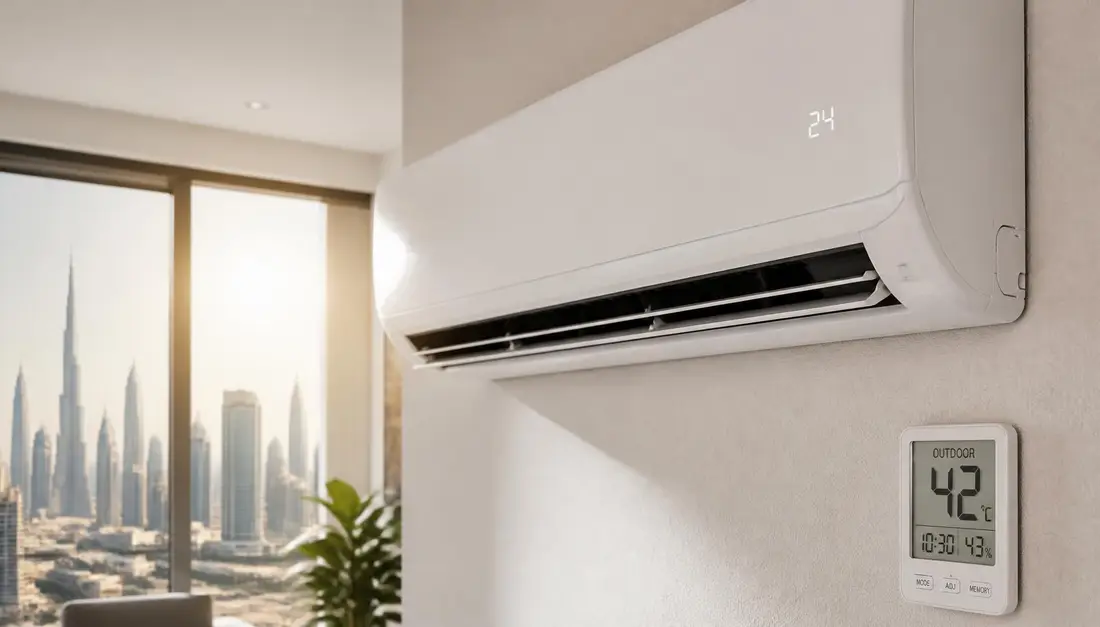
You switch the AC on, the display lights up, the fan is clearly moving air, but what's coming out of the vents is warm. In a city where the outdoor temperature sits above 45 °C for most of the summer, this is one of the fastest ways an ordinary afternoon turns into an emergency, and why emergency AC repair in Dubai exists.
Quick answer: A running AC that blows warm air usually means the cooling side of the system has stopped working while the fan keeps circulating air normally. The most common causes in Dubai homes are a dirty filter, low refrigerant, a blocked outdoor condenser, a frozen evaporator coil, a thermostat fault, or an electrical or compressor issue. Most are solved in one AC repair in Dubai visit, or with an AC gas refill when refrigerant is low.
Why This Happens So Often in Dubai Specifically
An AC unit does two separate jobs. The fan moves air through the room. The compressor, condenser, and evaporator coil actually remove the heat from that air. These two systems can work independently of each other, which is why a unit can sound completely normal, fan running, display lit, while the part that actually cools has failed quietly in the background.
In Dubai, this failure happens faster than in most climates for a simple reason: units here run 10 to 16 hours a day for eight or nine months of the year. That kind of continuous load, combined with fine desert dust and salt air near the coast, wears down filters, coils, and electrical components at a pace most manufacturers never designed for.
6 Common Causes of AC Blowing Warm Air
1. Dirty or Clogged Air Filter
This is the cause we find most often on service calls, and it's also the easiest to fix yourself. A blocked filter starves the evaporator coil of airflow, so even a fully functional refrigerant system can't cool the air passing through it.
How to check: Pull the filter out and hold it up to a light source. If you can't see light coming through clearly, it needs cleaning or replacing. In Dubai's dust conditions during summer, this can happen in three to four weeks rather than the standard three-month cycle quoted for milder climates.
2. Low Refrigerant or a Refrigerant Leak
Refrigerant is the substance that actually absorbs heat from the air inside your home. If the level drops due to a leak, usually from a joint or coil weakened by years of expansion and contraction in extreme heat, the system keeps running but loses most of its cooling ability.
Signs to look for: A hissing sound near the indoor or outdoor unit, ice forming on the copper refrigerant lines, or cooling performance that has been getting steadily worse over several days rather than failing suddenly.
Important: Refrigerant work needs a certified technician with the right gauges and recovery equipment. Adding refrigerant without finding and sealing the leak first is a temporary fix that wastes money.
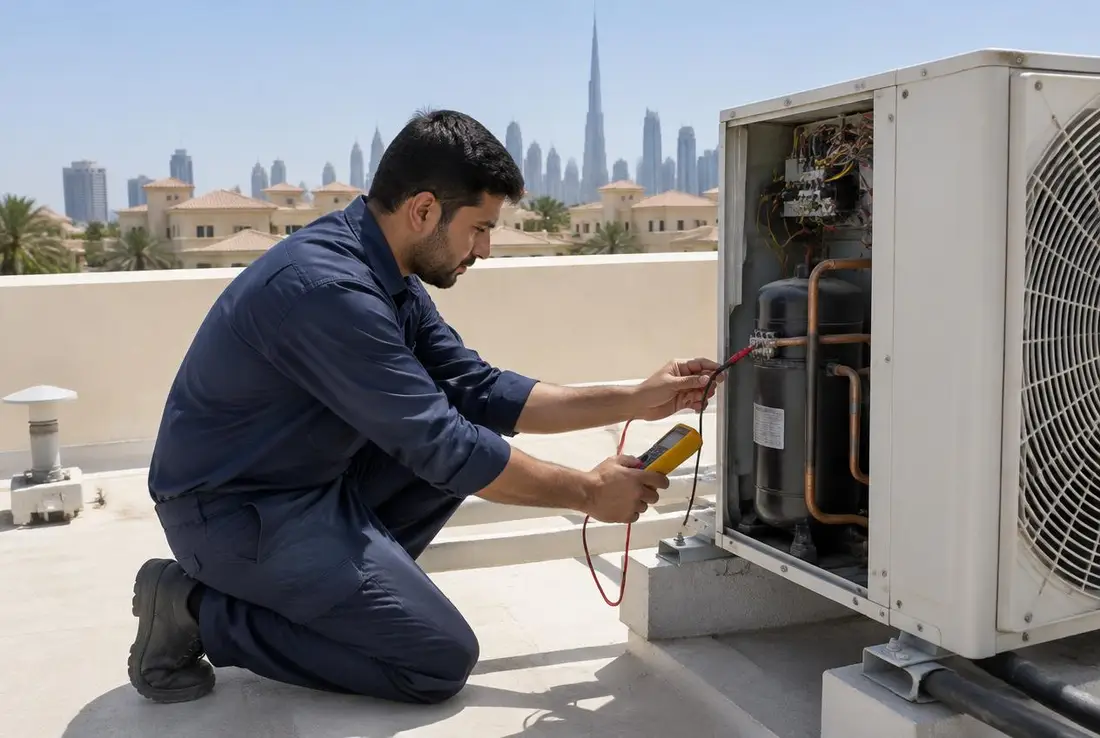
3. Dirty or Blocked Outdoor Condenser Unit
The condenser unit sits outside and its job is to release the heat your AC has pulled out of your home. When its fins are coated in dust or blocked by debris, that heat has nowhere to go, and the system's cooling capacity drops sharply. This is especially common in Dubai during shamal season, when wind-blown sand settles directly onto the outdoor coils.
How to check: Walk outside and look at the condenser. If the fins are visibly grey, caked, or surrounded by leaves or debris, restricted airflow is very likely part of the problem.

4. Frozen Evaporator Coil
A frozen coil is usually the end result of one of the two problems above. Once ice forms across the coil surface, it blocks heat exchange almost entirely, so air keeps blowing but carries no cooling with it.
How to check: Look at the indoor unit and the visible copper piping. If you see frost or ice, turn the system off completely and let it thaw for a few hours before running it again. Running it while frozen usually makes the underlying problem worse.
5. Thermostat Fault or Incorrect Settings
Sometimes the refrigerant side of the system is working perfectly fine and the problem is a thermostat that's either set wrong or misreading the room temperature.
How to check: Confirm the mode is set to "Cool," not "Fan" or "Auto," and that the target temperature is set well below the current room reading. If the display seems accurate but cooling still doesn't happen, the sensor itself may be faulty.
6. Electrical Fault or Failing Compressor
The compressor is what actually drives the refrigerant cycle, and it's powered separately from the indoor fan. A tripped breaker, a failed capacitor, or a compressor nearing the end of its life can all stop the outdoor unit from starting, while the indoor unit keeps blowing air as if nothing is wrong.
How to check: Stand near the outdoor unit while the AC is set to cool. If you don't hear or feel it running (no hum, no vibration), the compressor likely isn't starting, and this needs a technician.
A Real Example From a Recent Job
Problem: A customer in Al Barsha called us saying their split AC had been running all night but the bedroom stayed uncomfortably warm, around 27 °C even with the thermostat set to 20 °C.
Diagnosis: On inspection, the indoor filter was clean and the thermostat settings were correct. The outdoor unit was running but sounded weaker than normal, and light frost was visible on the copper line near the indoor unit.
Solution: A refrigerant pressure test found the system was significantly undercharged. Further inspection located a small leak at a flare joint on the outdoor unit, likely from years of vibration loosening the connection. The joint was resealed and the system was recharged to the correct refrigerant level.
Result: Cooling returned to normal within the hour, with the room reaching the target temperature in under 20 minutes on the next cycle. The customer was advised to book an annual check going forward to catch slow leaks like this one before they cause a full breakdown.